Check Deadbolt Door Preparation Before Buying
Record the door and deadbolt measurements, then compare them with the exact model’s current installation template.
Jump to a section
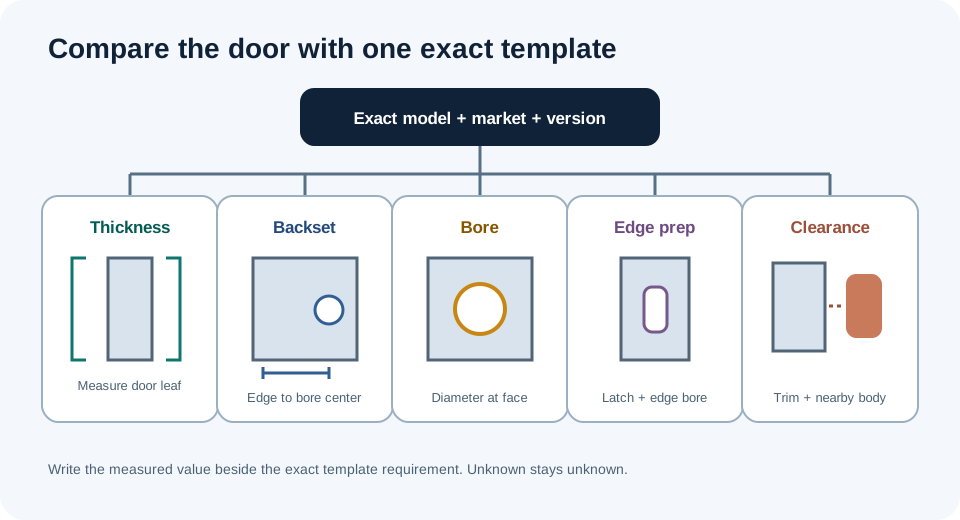
“Fits a standard deadbolt” is not a measurement. A useful check compares the door you have with the current installation template for the exact smart-lock model, market, and version.
Record the door
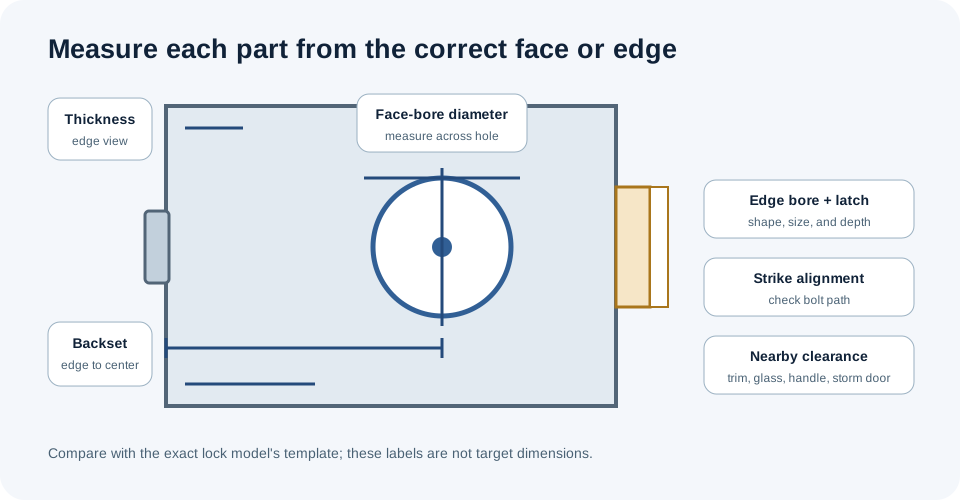
Start with the lock model and the side of the door where the smart mechanism will sit. Then record:
- door thickness at the lock;
- backset, measured from the door edge to the center of the deadbolt bore;
- face bore diameter and edge bore size or depth;
- latch faceplate shape and the strike opening;
- clearance from nearby trim, handle, glass, storm door, or second lock;
- center-to-center spacing and body overlap when another bore shares the door.
For an inside retrofit, also check the exact tailpiece shape and projection, adapter, cylinder housing, mounting plate, and interior surface. A product can pass the bore and backset checks but fail at one of these interfaces.
Compare against one exact template
Schlage’s Canada-hosted BE467F instructions give one model-specific example: 35–44 mm door thickness, 60 or 70 mm backset, 53 mm crossbore, and 25 mm edge bore. Those values describe that BE467F preparation path, not a North American standard. Other models can use different limits or require a specific latch, strike, or accessory.
Write down the manual’s unit, measurement point, allowed range, and stated modification. Do not round a near-limit measurement into a pass. If the manufacturer permits a smaller hole to be enlarged, follow its exact instructions; that does not authorize an unlisted change to a larger, misaligned, fire-rated, or unknown door.
Record the result
Mark each condition as within the exact model’s published requirement, outside it, or not documented. A missing threshold is unknown, not permission to substitute another model’s dimensions. After installation, test the lock only as its instructions direct. If the latch or bolt does not operate normally, stop and use the maker’s guidance or a qualified installer.
Tapo’s DL100/DLW10 installation FAQ gives one model-specific operation check: the door should operate without pushing or pulling, and the bolt’s handedness and calibration follow that product’s sequence. Do not transfer those setup steps to another model.
As examples of why visible hardware needs identification, Kwikset’s preparation support distinguishes the 158/780 deadbolts’ 1-1/2-inch bore and thick-door-kit path from the 660’s listed preparation. Schlage describes its B80 as a one-sided deadbolt with a partial 1-1/2-inch bore. These are existing-hardware identification clues; they do not establish smart-lock fit.
Use the retrofit-versus-replacement guide to identify the right installation path. If thickness is the problem, see thick-door and clearance checks.
Reference material