Identify a Euro, UK Oval, Scandinavian, or Other Cylinder
Identify the cylinder profile, record each side and its key function, and carry the right details into an exact smart-lock compatibility check.
Jump to a section
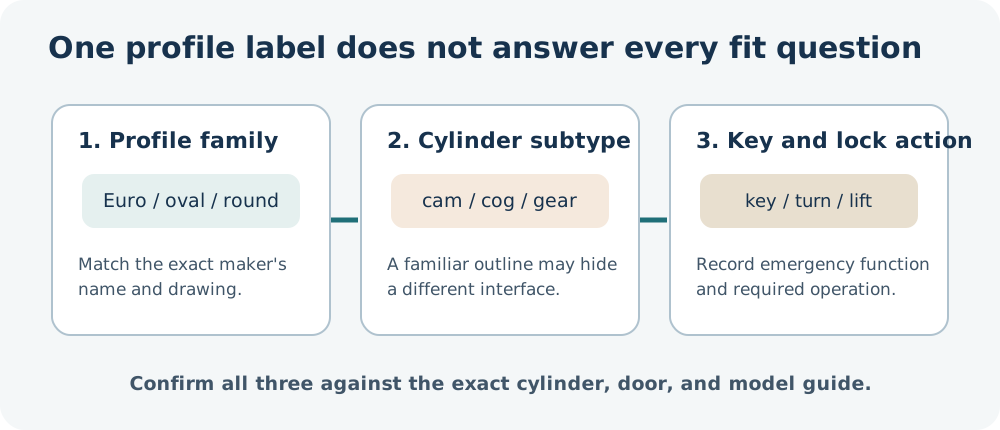
A cylinder’s profile is one part of a door record. It does not identify the cam, key function, lock case, or smart-lock model that can operate it. Use the profile name and measurement drawing from the exact cylinder or door-system manufacturer; leave the result unknown if you cannot match them safely.
Start with the manufacturer’s profile name
Names you may encounter include Euro/DIN, UK oval, Scandinavian oval or round, Finnish, Swiss round, and proprietary or other profiles. Manufacturer checkers may group these differently. Yale’s Linus checker, for example, presents Euro/DIN, Scandinavian, and Finnish paths, while EVVA lists European, Scandinavian oval, and Swiss round profiles. These are manufacturer-specific identification paths, not a shared compatibility list. Aqara’s U200 announcement names UK oval and select Scandinavian cylinders on that model’s path; it is an example of one manufacturer’s terminology, not a general fit claim.
Look at the cylinder face and the door edge, and record visible markings and the installed door or lock model. Compare those clues with the exact maker’s current diagram. A familiar outline or a country label is not enough to choose a replacement or smart-lock adapter. If the diagram does not match clearly, record “unknown” and ask the cylinder manufacturer or a locksmith; do not remove or dismantle an unfamiliar cylinder just to identify it.
Measure the two sides separately
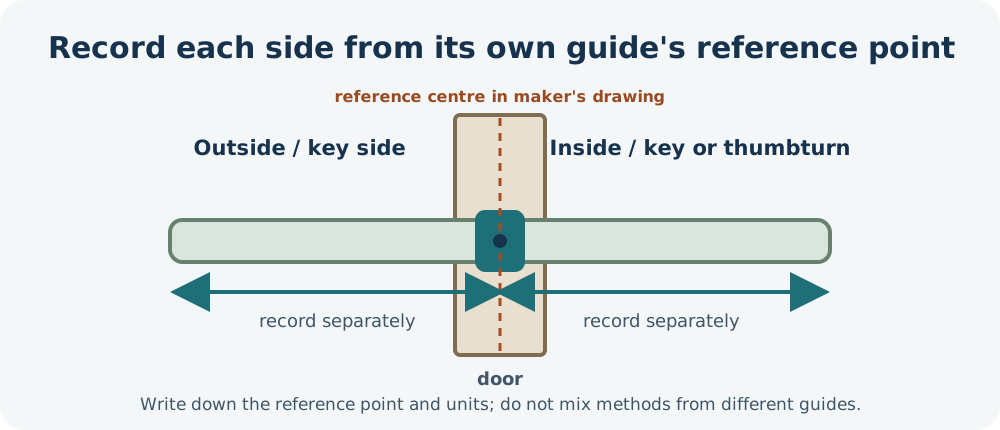
Use the exact maker’s drawing and view convention to mark which side faces outside and inside, then record each side independently. Write the drawing’s reference point and the units beside the measurements. GERDA’s EXXO SMART manual measures its own cylinder to the centre of the mounting-screw socket; Yale’s Adjustable Cylinder guide uses the cam centre. These model-specific examples show why the reference point matters; do not combine methods or transfer an accessory’s dimensions to another cylinder.
Also record how far the cylinder projects beyond the inside furniture, whether there is a key or thumbturn on each side, and whether the cylinder is a double, half, or thumbturn type. dormakaba’s digital-cylinder factsheet, for example, lists standard, dual, half, and antipanic variants and names Euro-profile 1435 and round-profile 1535; these are options in that product family, not a general taxonomy. Yale’s Adjustable Cylinder and Aqara U200 cylinder manual give measurements and spacer steps for their own accessories. Their instructions do not define a general Euro or Scandinavian size range.
Keep the cam and lock action in the record
A Euro-profile outline can hide a different cam. Yale explains that its Cog cylinder can share the Euro profile shape while using a cog cam; Yale’s Adjustable Cylinder does not work with that Cog cylinder. Check the cylinder subtype and the exact device instructions instead of relying on the outline.
Then describe what the lock case needs to do: turn a deadbolt, move a latch, lift a handle, or operate several points. For example, Nuki’s Ultra Nordics guide lists typical Scandinavian oval or round cylinders with an inside key or thumbturn, but still requires a deadbolt and excludes latch-only operation. That is a named model’s boundary, not a rule for every Scandinavian lock.
Check key and emergency function separately
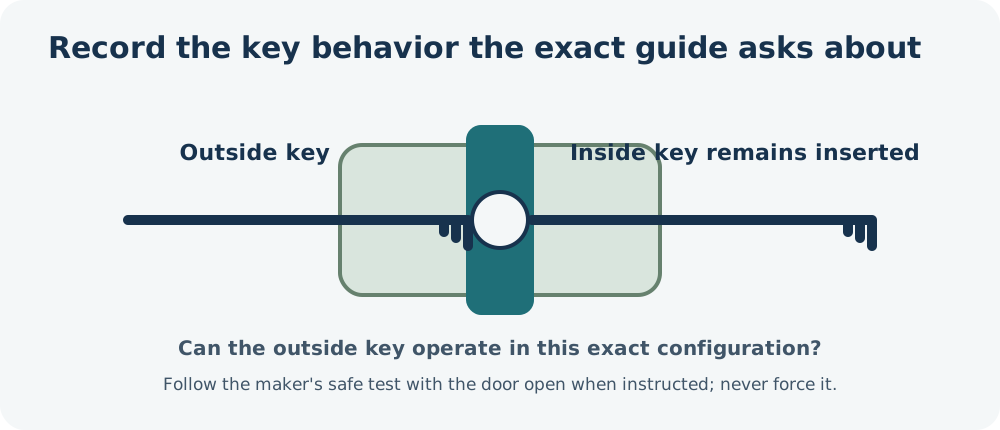
Write down whether a key can operate the cylinder from outside while another key remains inserted inside. Manufacturers use terms such as emergency, double-clutch, or panic. For Tedee GO2, Tedee describes the emergency function as one inserted key turning the other; its GO manual calls this the double-clutch or panic function. That is a named product’s description, not a universal test or proof of fit. Follow the exact product instructions, keep the door open when required, and do not force a stiff key or cylinder. If the function is unclear or important to the door’s normal use, ask the cylinder manufacturer or a qualified locksmith to check it.
Prepare a model-ready cylinder record
Before comparing smart locks, note:
- Country or market, door or lock maker, exact model, and any visible marking.
- Profile name as shown by the cylinder maker, plus the drawing or checker used to identify it.
- Separate inside and outside lengths, their reference point, units, and inside projection.
- The normal key or thumbturn action on each side, and any special variant named in the exact cylinder guide.
- Key, thumbturn, double-cylinder, half-cylinder, or other arrangement.
- Cam or gear type when the manufacturer identifies one.
- Whether an inside key prevents outside operation, and the source-specific test result if checked.
- The lock action the smart device must reproduce, including a deadbolt, latch, handle lift, or multipoint sequence.
Carry the measurements into the general door record and the required action into the lock-action guide. For several locking points, use the multipoint checklist. Compare the full record with the exact smart-lock model and market. A matching profile name is not a compatibility verdict.
Reference material
Sources for this guide
- Linus Compatibility CheckerPrimary
- How to Install: Linus Smart Lock on your Yale Linus Adjustable CylinderPrimary
- Aqara Announces Global Availability of Smart Lock U200Primary
- GERDA EXXO SMART Modular Cylinder — Installation and Use Manual (Rev. 7)Primary
- Nuki Smart Lock Ultra Nordics: Compatibility GuidePrimary
- dormakaba digital cylinder factsheetPrimary
- Aqara Adjustable Cylinder for Smart Lock U200 User ManualPrimary
- Installation Guide and User Manual — Tedee GOPrimary
- Tedee GO2Primary
- CylindersPrimary