Make a Smart-Lock Compatibility Checklist When the Door Is Unknown
Turn an unidentified or unusual door into a clear compatibility request with the market, normal operation, useful measurements, and safe next step.
Jump to a section
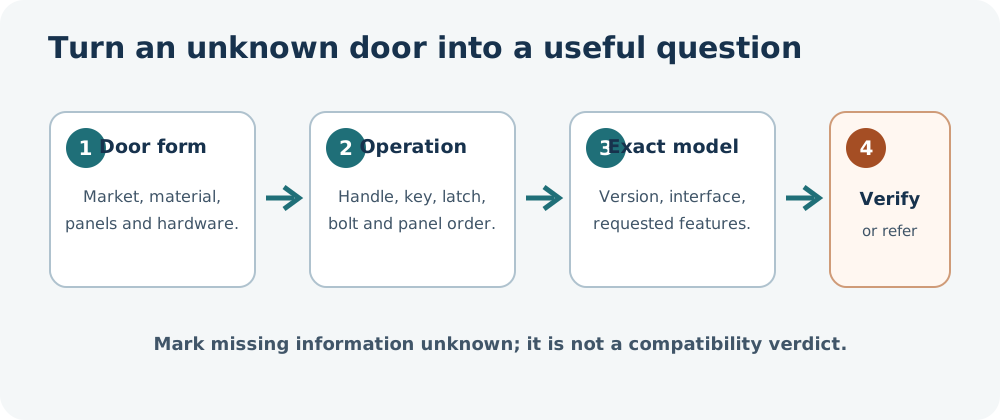
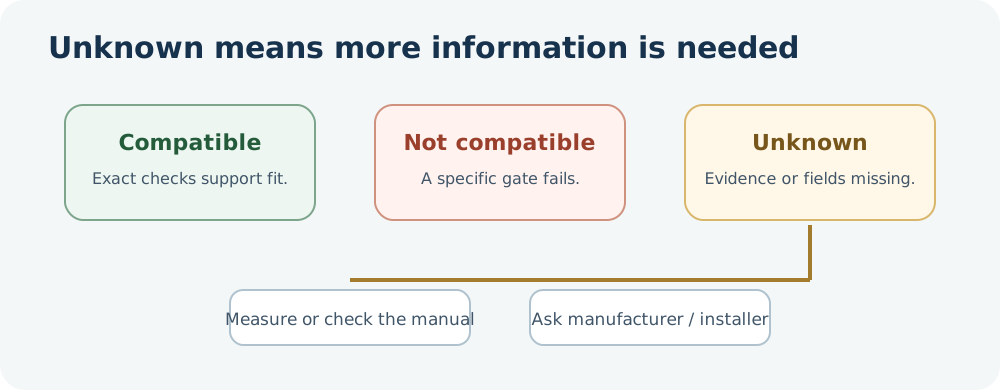
If you do not know the door or lock type, do not choose a smart lock from a photo or a product-family name. Build a short record first. “Unknown” means you need more information; it does not mean the lock is incompatible.
Fill in what you can identify
| Field | Your notes |
|---|---|
| Country or market | |
| Door type and material | |
| Door or lock brand, series, and visible model markings | |
| If already electronic: exact lock model, generation, market version, and mounting/interface shown in its guide | |
| Does the door open inward or outward? Which side did you observe from? | |
| Which panel opens first, if there is more than one? | |
| What does the inside handle, key, or thumbturn do, and in what order? | |
| Does the handle need to lift before the key turns? | |
| Does one bolt move, a latch move, or several points move along the door edge? | |
| On a two-bore door, does one inside lever retract both latch and deadbolt, or are the bodies separate? Record center spacing and any visible overlap. | |
| Is there a key on one side or both? Is there an inside thumbturn? | |
| Which exact smart-lock model and country version are you checking? | |
| Which app or smart-home features do you need? |
Add measurements only when the guide asks for them
A model’s compatibility checker may ask for door thickness, backset, face bore, edge bore, cylinder dimensions, frame clearance, or strike details. The useful measurements depend on the mechanism and product. Use the exact manufacturer diagram, preserve its units, and mark a field unknown if you cannot measure it accurately. Do not enlarge holes or remove a cylinder just to complete a checklist.
For a cylinder, record the profile name and the inside and outside lengths using that exact guide’s reference point. For a multipoint door, photograph the full edge and record the normal handle, key, and panel sequence. A category name or familiar silhouette cannot stand in for those details.
For two separate North American lock bodies, record the bore center spacing and whether their actual bodies overlap. Schlage’s CS210 is a named example where one inside-lever movement retracts both latch and deadbolt; a separate FE789 lever and Encode deadbolt are a different arrangement. These examples describe specific products, not a general spacing limit. If you cannot identify the installed function or model, leave it unknown and ask the exact manufacturer or a qualified installer.
Take photos without exposing access information
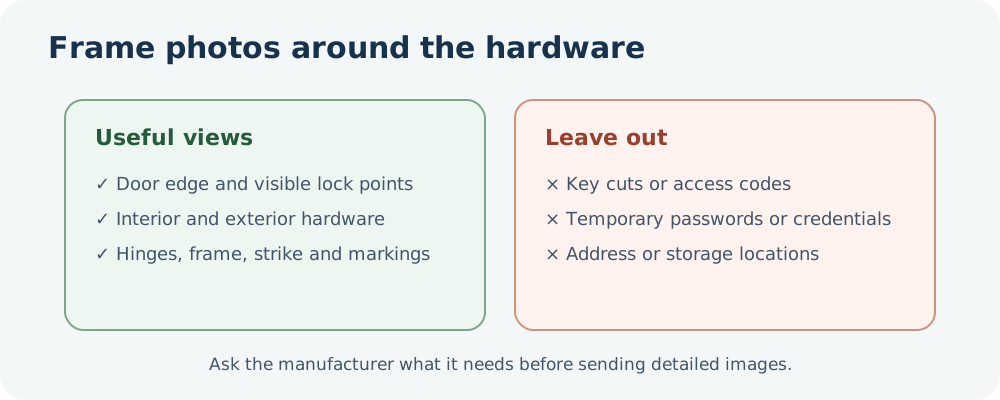
If you need to send photos to a manufacturer or installer, useful views may include the door edge, interior and exterior hardware, hinges, frame or strike, handle, and visible model markings. Do not share key codes, access codes, temporary passwords, the full address, or a photo that reveals where credentials are stored. Ask the manufacturer what it needs before sending detailed images.
Separate physical fit from smart-home features
Write down the exact ecosystem, app features, controller, hub, border-router, and firmware requirements you need checked. A lock may fit mechanically while lacking the remote access, automations, voice control, or local operation you want. Conversely, platform support does not establish that the lock can operate your door.
Choose a safe next step
- Ready for an exact model check: You have the model and market, the mechanism and operating sequence, and the measurements required by the current manual.
- More information needed: One or more important fields remain unknown. Measure only what the exact guide requests or ask the manufacturer for help.
- Professional identification needed: The door has unusual or multiple mechanisms, the emergency or panel sequence is unclear, the lock is damaged or stiff, or changes could affect shared access or emergency egress.
These outcomes are an intake aid, not a compatibility certification. Do not treat an unknown door as compatible or incompatible. Ask the exact lock manufacturer or a qualified locksmith or installer to assess unresolved fit and operation before purchase or modification.
Reference material
Sources for this guide
- Linus Compatibility CheckerPrimary
- Schlage Control Smart Deadbolt Door Preparation InstructionsPrimary
- U200 Installation MethodsPrimary
- Smart Lock U400: Unlocks on Approach with UWBPrimary
- CS200 Series Grade 2 Interconnected LockPrimary
- Can You Install an Encode Lever and Another Encode Series Deadbolt on the Same Door?Primary