Measure a North American Deadbolt: Bore, Backset, Strike, and Clearance
Check the door preparation and operating details that affect a US or Canadian deadbolt replacement or retrofit before selecting a smart lock.
Jump to a section
A deadbolt retrofit and a deadbolt replacement are different installation paths. A retrofit turns the existing inside thumbturn or tailpiece; a replacement removes the existing bolt and installs new hardware in the door. Check which path the exact product uses before comparing measurements.
A common single-cylinder deadbolt has a key outside and a thumbturn inside. A double-cylinder deadbolt uses a key on both sides. Those labels describe the hardware arrangement; they do not by themselves establish that a smart lock supports the lock, door, or local installation requirements.
Check operation before measuring
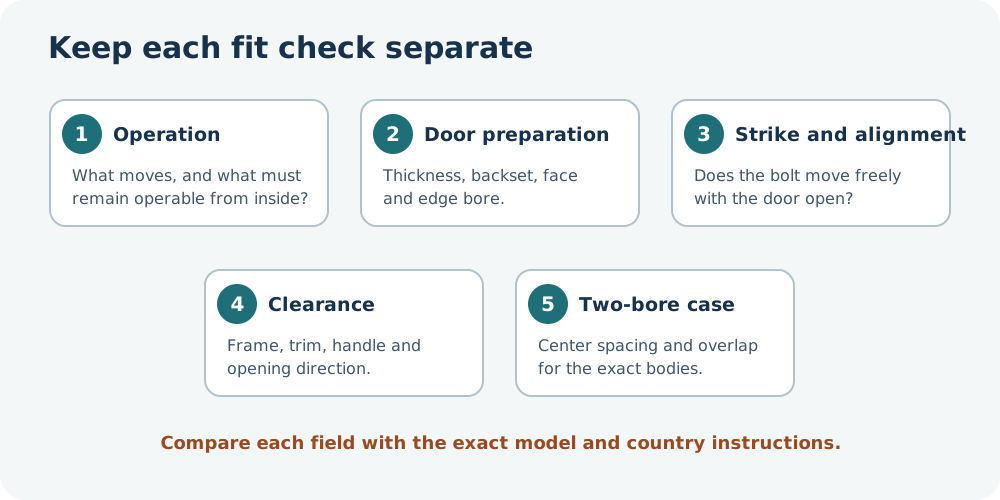
With the door open, turn the existing thumbturn or key normally and watch the bolt move. When it is safe to do so, note whether the door can close and lock without lifting, pushing, or pulling it. Do not force a stiff bolt or change the strike to make a smart lock fit. Schlage’s preparation guidance treats smooth alignment as a separate check from hole dimensions.
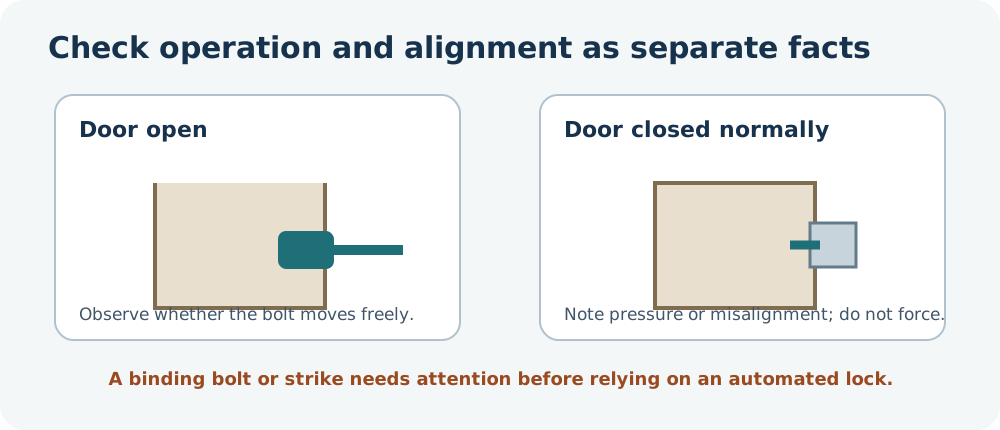
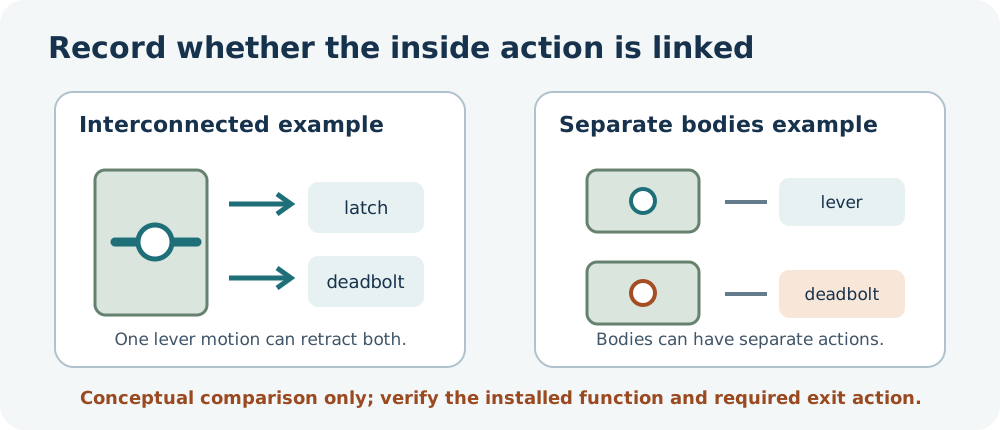
Record whether the inside mechanism is a thumbturn or key, whether the outside key remains usable after a retrofit, and whether any handle or separate latch must also move. A fit result for the bolt does not establish that a device can lift a handle or operate a second locking point.
Some North American sets link the inside lever, latch, and deadbolt. Schlage describes the CS210 function as retracting both latch and deadbolt with one inside-lever motion. Record whether your installed set has this linked action; do not assume a retrofit or separate replacement parts preserve it. This is an example of the named product’s function, not a rule for all interconnected locks.
Measure the preparation
For the exact product guide, record:
- Door thickness. Measure the slab across its edge. Note whether the manual gives a supported accessory or replacement path outside its basic range.
- Backset. Measure from the door edge to the centreline of the large face bore. Do not confuse 2-3/8 inches and 2-3/4 inches settings.
- Face bore and edge bore. Record the large cross-hole through the face and the smaller hole through the edge. Include depth where the manual specifies it.
- Strike and jamb. Note the strike shape, hole position, and how freely the bolt enters the frame. A door that needs pressure to align needs attention before an automated lock is relied on.
- Clearance. Measure around the deadbolt centre, handle, frame, trim, and wall. Note the opening direction because the required space may change with swing.
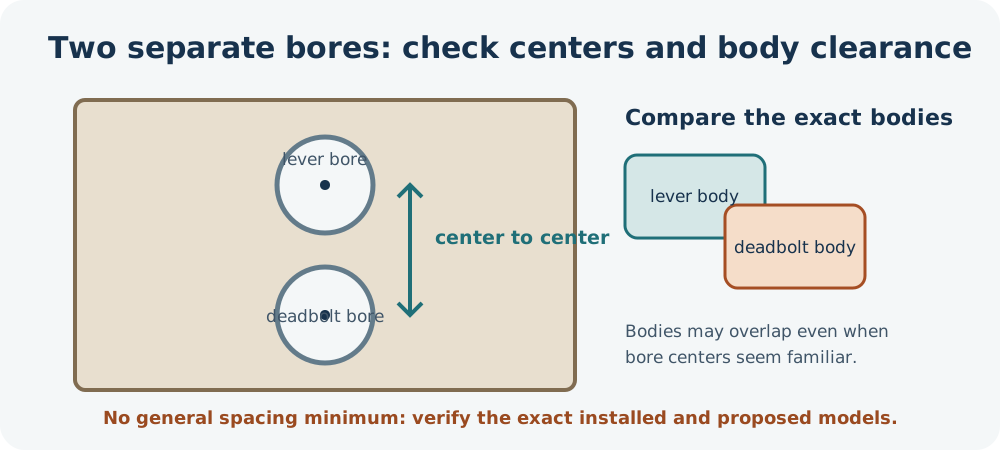
- Two-bore spacing and body clearance. If a lever and deadbolt use separate bores, measure center-to-center spacing and note whether the proposed lock bodies overlap. Use the exact model drawings; do not treat a typical spacing as a safe minimum for another product.
- Exact model and market. Record the model code, generation, and country. U.S. preparation values are not proof of Canadian or UK parity.
Compare exact published examples, not “standard” sizes
| Product guide | Example gates stated by that source | What the example does not establish |
|---|---|---|
| Schlage Control BE467F | Door thickness 1-3/8 to 1-3/4 inches; backset 2-3/8 or 2-3/4 inches; 2-1/8 inch face hole; 1 inch edge hole. The guide says larger existing holes will not fit properly and describes enlargement for smaller holes. | Fit for other Schlage models, other brands, or an installed door whose bolt binds. |
| Schlage Sense | Door thickness 1-3/8 to 1-3/4 inches; 2-3/8 or 2-3/4 inch backset; 2-1/8 or 1-1/2 inch crossbore; 1 inch edge hole at least 1 inch deep; 5 inch minimum from the door stop. | Fit for BE467F or other Sense generations. The thick-door kit is a named path, not a general range. |
| August Smart Deadbolt with Wi-Fi | Its product page describes a replacement deadbolt path and lists a 1-3/8 to 1-3/4 inch door, 2-1/8 inch bore, 1 inch edge bore, and 2-3/8 or 2-3/4 inch backset. | A retrofit over any existing deadbolt or regional availability. Check the purchased package and guide. |
| Aqara U200 U.S. page | Lists a single-cylinder deadbolt path and 2-3/8 or 2-3/4 inch backsets. | A complete mechanical fit verdict. Other product and door requirements still apply. |
| Nuki U.S. guides | The compatibility guide gives separate frame and handle clearances by swing. The U.S. Deadbolt mounting guide checks tailpiece overhang with its supplied card before choosing a direct or extension-plate mount and one of three supplied adapters. | The exact card determines the model-specific tailpiece range; these guides do not establish a universal limit, full door geometry, or Canadian/UK requirements. |
| Aqara U400 U.S. page and January 2026 launch announcement | The U.S. page names single-cylinder deadbolts and requires its supplied strike; Aqara’s launch announcement listed U.S. and Canadian availability. | Neither source establishes a full preparation matrix, Canadian package parity, or current stock. Check the exact model, channel, and installation guide. |
| Schlage CS200/CS210 | The product page describes a linked inside-lever action that retracts both latch and deadbolt; it lists product-specific door preparations. | The linked action and dimensions are specific to the named CS200/CS210 function. They do not show that another device preserves the installed exit action. |
| Schlage FE789 lever with BE489/BE499 deadbolt | Allegion warns that typical 5-1/2-inch bore spacing can leave these named bodies overlapping and discusses greater spacing for that pairing. | Allegion disclaims accuracy and completeness. Verify exact product drawings and the installed door; this is not a general spacing minimum or permission to alter a door. |
Treat every row as an example from that named source. The cited pages do not combine into one accepted dimension table. Do not enlarge holes or modify a door from this summary; use the exact manufacturer procedure and a qualified installer where the door construction or permission is uncertain.
When the answer is not yet clear
Pause and seek an exact manual or professional check if you have a double-cylinder or interconnected lock, a metal or glass door, nonstandard trim, an unusual deadbolt, a damaged door, a shared entrance, or a door that does not align smoothly. Mark the result unknown until the exact product and opening have been checked.
For a record that covers other door mechanisms and cylinder types, continue with the general measurement guide or the unknown-door checklist.
Reference material
Sources for this guide
- Schlage Control Smart Deadbolt Door Preparation InstructionsPrimary
- Schlage Sense Installation InstructionsPrimary
- Smart Deadbolt with Wi-FiPrimary
- Aqara Smart Lock U200Primary
- Smart Lock U400: Unlocks on Approach with UWBPrimary
- Aqara Introduces UWB-Powered Smart Lock U400 at CES 2026Primary
- Nuki Smart Lock: Compatibility GuidePrimary
- Smart Lock (U.S. Deadbolt): mounting & installationPrimary
- Install door hardware with ease with this door prep checklistPrimary
- CS200 Series Grade 2 Interconnected LockPrimary
- Can You Install an Encode Lever and Another Encode Series Deadbolt on the Same Door?Primary